Chronic Kidney Disease in Dogs


Adobe_stock/Alan
Chronic kidney disease (CKD) in dogs is a progressive condition in which the kidneys gradually lose their ability to function properly.
Because early kidney disease often causes few or no obvious symptoms, routine blood work and urinalysis are essential for detecting the disease before significant kidney damage occurs.
Although CKD cannot be cured, early diagnosis and long-term management can help improve your dog’s comfort and quality of life.
Key Takeaways
- Chronic kidney disease is progressive and irreversible.
- Early disease often causes few noticeable symptoms.
- Blood work and urinalysis are the primary diagnostic tests.
- Diet, medications, and fluid therapy help manage CKD.
- Early diagnosis improves long-term quality of life.
What Is Chronic Kidney Disease in Dogs?
Chronic kidney disease (CKD) in dogs is a progressive condition in which the kidneys gradually lose their ability to function properly.
The kidneys perform many essential functions, including:
- Filtering waste products and toxins from the bloodstream
- Maintaining fluid, mineral, and electrolyte balance
- Conserving water and important blood proteins
- Helping regulate blood pressure
- Supporting red blood cell production
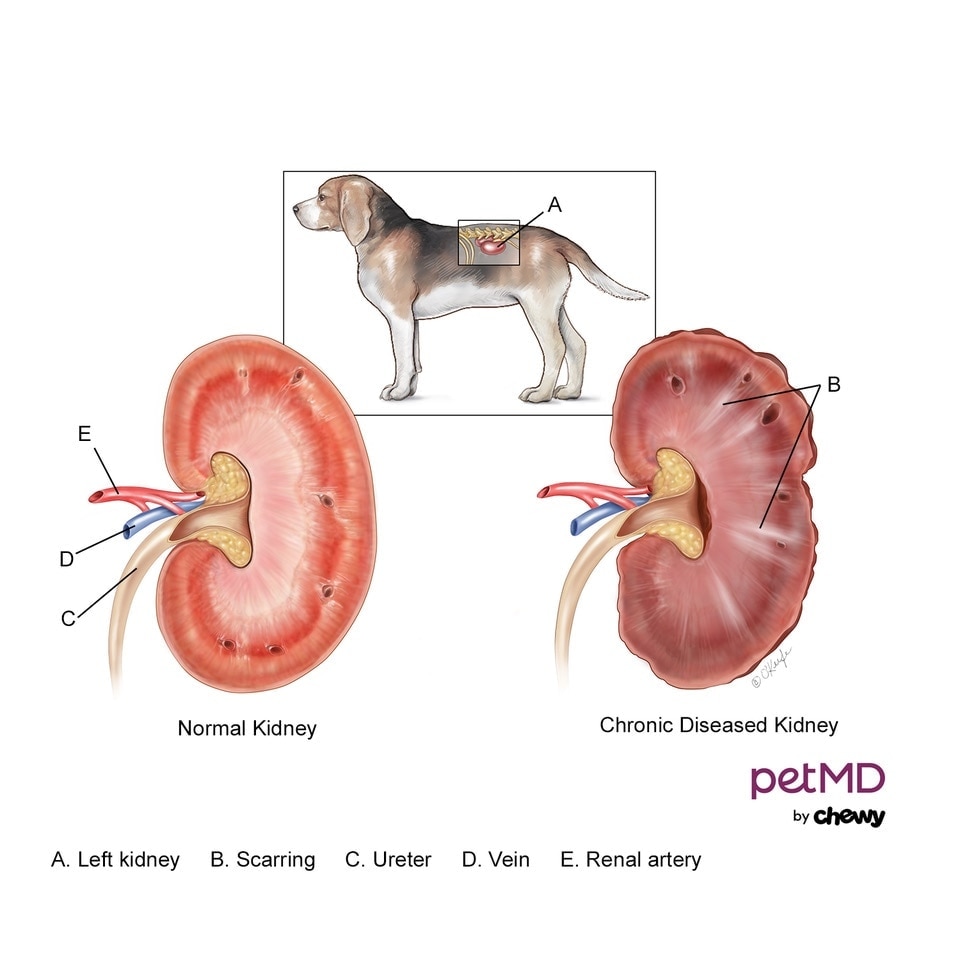
Download the medical illustration of chronic kidney disease in dogs.
As kidney function declines, waste products and toxins accumulate in the bloodstream, leading to nausea, malaise, and a gradual decline in your dog's quality of life if the disease is left untreated or unmanaged.
Unfortunately, the loss of kidney function is irreversible. Once kidney tissue is damaged, it cannot regenerate.
Chronic kidney disease often develops gradually and may be present for months or even years before it is diagnosed. The disease progresses at a different rate in every dog, making it difficult to predict how quickly it will worsen.
Veterinarians typically classify CKD into four IRIS stages (Stages I–IV) based on laboratory test results and a dog's clinical signs. Staging helps guide treatment recommendations and long-term management.
Symptoms of Chronic Kidney Disease in Dogs
Dogs with chronic kidney disease often don't develop noticeable symptoms until approximately 75% of kidney function has been lost.
As CKD progresses, symptoms typically become more frequent and more severe. Dogs in later stages of the disease generally experience a greater number of clinical signs than those in earlier stages.
Symptoms of chronic kidney disease may include:
- Increased thirst
- Increased urine production or other changes in urination
- Decreased appetite
- Weight loss
- Muscle wasting
- Weakness and lethargy
- Dehydration
- Nausea
- Intermittent vomiting
- Oral ulcers (mouth sores) and bad breath
- Pale gums
- Poor coat quality
- Anemia (low red blood cell count)
- Vision loss, often related to secondary hypertension (high blood pressure)
Because many of these symptoms are common to other medical conditions, blood work and urinalysis are needed to confirm a diagnosis of chronic kidney disease.
Causes of Chronic Kidney Disease in Dogs
In many dogs, the exact cause of chronic kidney disease (CKD) is never identified, but several injuries and medical conditions can contribute to permanent kidney damage.
By definition, chronic kidney disease is an ongoing, progressive, and irreversible condition that develops over time.
Some dogs develop CKD after a serious kidney injury, including:
- Severe infections, such as leptospirosis, tick-borne diseases, or pyelonephritis (kidney infection)
- Heatstroke
- Envenomation from venomous bites or stings
- Exposure to toxins, including antifreeze, nonsteroidal anti-inflammatory drugs (NSAIDs) such as ibuprofen, or certain antibiotics
Chronic kidney disease has also been associated with some immune-mediated diseases and certain types of cancer.
Some dog breeds appear to have a higher risk of developing chronic kidney disease, including:
- Basenji
- Bernese Mountain Dog
- Boxer
- Bull Terrier
- Cairn Terrier
- Cavalier King Charles Spaniel
- Cocker Spaniel
- English Cocker Spaniel
- Shar-Pei
- West Highland White Terrier
How Veterinarians Diagnose Chronic Kidney Disease in Dogs
Veterinarians diagnose chronic kidney disease using a combination of a physical examination, blood tests, urinalysis, and, when needed, additional diagnostic testing.
Initial testing typically includes blood work and a urinalysis to evaluate kidney function and identify changes commonly associated with CKD.
|
Test |
Why It's Important |
|
Blood urea nitrogen (BUN) |
Higher levels may indicate reduced kidney function. |
|
Creatinine (Cr) |
Measures the kidneys' ability to filter waste from the bloodstream. |
|
Symmetric dimethylarginine (SDMA) |
Helps detect kidney disease earlier than some traditional markers. |
|
Urine specific gravity |
Evaluates the kidneys' ability to concentrate urine. Low values may indicate kidney disease. |
|
Phosphorus |
Often increases as kidney disease progresses. |
|
Calcium |
May become elevated in advanced CKD. |
|
Electrolytes (sodium, potassium, chloride) |
Help assess hydration status and kidney function. |
|
Red blood cell count |
Low values may indicate anemia associated with more advanced CKD. |
Depending on the results, your veterinarian may also recommend:
- A urine protein-to-creatinine (UPC) ratio to evaluate protein loss in the urine (proteinuria).
- A urine culture to check for urinary tract infections, which are more common in dogs with CKD.
- Blood pressure measurement because hypertension commonly occurs with chronic kidney disease.
- Abdominal radiographs (X-rays) or ultrasound to evaluate for kidney stones, tumors, or kidney infarcts.
- A kidney biopsy in rare cases when additional information is needed.
Treatment for Chronic Kidney Disease in Dogs
Although chronic kidney disease (CKD) cannot be cured, many dogs can be successfully managed with diet, medications, and supportive care to improve their quality of life.
Treatment recommendations are based on your dog's stage of CKD. Dogs in IRIS Stages III and IV generally require more intensive treatment than those in Stages I and II.
Medications
Medications are commonly prescribed to control symptoms associated with CKD, including nausea, vomiting, and decreased appetite.
Common medications may include:
- Cerenia®
- Ondansetron
- Omeprazole
- Capromorelin (appetite stimulant)
- Mirtazapine (appetite stimulant)
Prescription Kidney Diets
Most dogs with CKD benefit from a prescription kidney-support diet that is lower in protein, phosphorus, and sodium while helping maintain a healthy acid-base balance.
Common veterinary diets include:
Fluid Therapy
Fluid therapy is an important part of managing chronic kidney disease because it helps improve hydration and flush waste products from the bloodstream.
Depending on your dog's condition, fluids may be administered:
- Intravenously (IV) in the hospital
- Subcutaneously (under the skin) at home
Dogs with CKD should always have access to fresh, clean water. Many veterinarians recommend using a pet water fountain to encourage increased water intake.
Management of Chronic Kidney Disease in Dogs
Managing chronic kidney disease requires lifelong monitoring, ongoing treatment, and regular veterinary care to help maintain your dog's quality of life.
Because CKD is a progressive disease, dogs typically require more frequent veterinary examinations and laboratory testing than healthy dogs. Your veterinarian will also monitor your dog's quality of life as symptoms change over time.
Continue all medications, prescription diets, and follow-up appointments exactly as recommended. Many treatments will be needed for the rest of your dog's life.
Long-term management may include:
- Dietary supplements such as Azodyl®, a prebiotic/probiotic product that may help reduce waste products normally eliminated by the kidneys.
- Phosphorus binders such as aluminum hydroxide or Epakitin® for dogs with elevated phosphorus levels.
- Potassium supplements such as Renal K+® for dogs with low potassium levels.
- Anti-nausea and anti-vomiting medications for dogs that experience intermittent vomiting or decreased appetite.
With consistent monitoring and individualized treatment, many dogs with chronic kidney disease can maintain a good quality of life for months or even years after diagnosis.
Chronic Kidney Disease in Dogs FAQs
How long can a dog live with kidney disease?
Some dogs with chronic kidney disease live for years with appropriate veterinary care and long-term management, while others may decline much more quickly.
Because CKD progresses differently in every dog, life expectancy depends on factors such as the underlying cause, the stage of disease at diagnosis, how well the disease responds to treatment, and the dog's overall health.
How fast does kidney disease progress in dogs?
The progression of chronic kidney disease varies widely from one dog to another.
In some dogs, the disease progresses slowly over several years, while others may decline much more rapidly. By the time symptoms become noticeable, it is estimated that approximately 75% of kidney function has already been lost, and the damage is irreversible.
Regular wellness exams, blood work, and urinalysis can help identify kidney disease earlier, allowing treatment to begin before symptoms become severe and helping maintain your dog's quality of life.
Can chronic kidney disease in dogs be cured?
No. Chronic kidney disease is irreversible and cannot be cured. However, many dogs can be successfully managed with prescription diets, medications, fluid therapy, and routine veterinary monitoring to help maintain a good quality of life.
What is usually the first sign of kidney disease in dogs?
One of the earliest signs of chronic kidney disease is increased thirst and increased urination. Because these changes can be subtle, routine blood work and urinalysis are important for early detection.